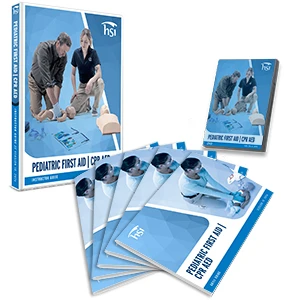
HSI Pediatric First Aid, CPR & AED | Instructor Program Package | G2025
$189.00
Program Overview
Prepare your students to respond confidently to emergencies involving children with the HSI Pediatric First Aid, CPR & AED G2025 Instructor Program Package. The program supports instruction in pediatric first aid and CPR AED for children, infants, and adults, with five certification options to accommodate different training needs. Designed for people responsible for children, including school staff, camp counselors, lifeguards, youth group leaders, and licensed childcare providers, the course serves individuals who are not healthcare providers or professional rescuers but require pediatric emergency care training. The program has been approved by the HSI Medical Advisory Board and reviewed by the HSI Advisory Council. Its curriculum reflects current resuscitation science and treatment recommendations from the International Liaison Committee on Resuscitation (ILCOR) and conforms with the 2025 American Heart Association (AHA) Guidelines Update for CPR and ECC, including annual updates.
Package Includes
-
HSI Pediatric First Aid | CPR AED Instructor Guide, G2025.
-
Five Pediatric First Aid | CPR AED Skill Guides.
-
Access to digital instructor tools in Otis.
Certification Options and Recommended Course Times
-
Pediatric First Aid + Child, Infant, and Adult CPR AED: 2¾–8¼ hours.
-
Pediatric First Aid + Child and Infant CPR AED: 2¼–7 hours.
-
Pediatric First Aid: 1–5 hours.
-
Child, Infant, and Adult CPR AED: 2½–5 hours.
-
Child and Infant CPR AED: 1¾–3¾ hours.
Training Formats and Instructor Tools
-
Delivery options: Traditional classroom instruction, blended learning, and Remote Skill Verification (RSV).
-
Instructional resources: Instructor Guide, Skill Guide, and program media presentation.
-
Video tools: Streaming and offline video playback with customizable playlists.
-
Digital evaluations: Pre-built performance evaluations to support student assessment.
-
Class management: Tracking for past, current, and upcoming classes.
Program Topics
Topics covered across the program include:
-
CPR and AED response: Child and infant cardiac arrest, adult sudden cardiac arrest, assessment, chest compressions, AED use, and one-provider CPR AED.
-
Additional emergency response skills: Adult airway and breathing skills, CPR mask use, choking relief, suspected opioid-associated emergencies, and drowning.
-
First aid assessment and bleeding: Initial assessment, external and internal bleeding, shock, minor and open wounds, nosebleeds, impaled objects, and amputations.
-
Injuries: Tooth and eye injuries; head, neck, and spinal injuries; concussion; abusive head trauma; bone, joint, and muscle injuries; and burns.
-
Medical emergencies: Altered mental status, poisoning, breathing difficulties, asthma, severe allergic reactions, seizures, diabetes, low blood sugar, fainting, and near-fainting.
-
Environmental emergencies: Heat and cold emergencies, bites, and stings.
Student Certification and Class Size
-
Certification period: Two years from the month of issue.
-
Skills evaluation: Students must demonstrate the required skills competently without assistance.
-
Written evaluation: Required when specified by organizational, local, or state regulation. Recommended for designated responders who have a duty or employer expectation to provide emergency first aid.
-
Recommended student-to-instructor ratio: Six students per instructor.
-
Maximum student-to-instructor ratio: Twelve students per instructor.